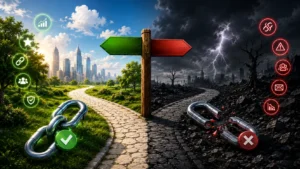
Quick Answer: In 2027, link building means earning high-quality backlinks and building brand mentions that AI tools like ChatGPT, Perplexity, and Google AI Overviews can cite. Backlinks still matter — but brand authority, digital PR, and unlinked mentions now play an equally important role. This guide covers exactly what works and what will get you penalized.
Is Link Building Still Worth It in 2027?
Short answer: Yes — but it looks very different from what it did three years ago.
Here’s what changed. Zero-click searches now account for over 68% of all Google searches in 2026. That means more than half your potential visitors are getting their answers directly from Google’s AI Overview — without ever clicking a link.
And here’s the part most SEOs are still missing:
Branded web mentions — not backlinks — now have the strongest correlation with appearing in AI Overviews. A recent Ahrefs analysis of 75,000 brands found that branded mentions showed a correlation of 0.664 with AI Overview visibility, compared to just 0.218 for traditional backlinks.
YouTube mentions? Even stronger. Around 0.737.
That doesn’t mean backlinks are dead. It means the game has expanded. You now need to win on two fronts: traditional search and AI search.
This guide breaks down exactly how to do both — with the 13 most important link-building dos and don’ts heading into 2027.
The 7 Biggest Link Building Mistakes in 2027
Mistake #1: Still Chasing Link Volume Over Quality
This mistake has been on the list for years. And it’s still the #1 reason websites fail at link building.
More links do not mean better rankings — especially in AI search. According to SE Ranking’s analysis of over 2.3 million pages, websites with stronger quality backlink profiles were cited more often in Google AI Mode. But the keyword is quality, not volume.
A website with 50 backlinks from highly relevant, trusted sources will outperform a website with 500 backlinks from generic or irrelevant blogs — every single time.
The rule for 2027: Ask yourself this before pursuing any backlink: “Would a real editor on this website link to my content naturally?” If the answer is no, it’s not worth your time.
Mistake #2: Ignoring Brand Mentions That Have No Link
This is the biggest blind spot in most link building strategies today.
When a journalist writes about your brand, when a Reddit user recommends your tool, when a podcast host namedrops your business — those unlinked mentions are now picked up by AI systems as trust signals.
What the data shows: AI tools like ChatGPT, Perplexity, and Google AI Overviews don’t just read links. They read the entire web as text and look for patterns of brand association. The more your brand is consistently mentioned in relevant, trusted contexts — linked or not — the more likely you are to be cited in AI answers.
Ignoring unlinked mentions in 2027 is like ignoring mobile SEO in 2016. You’ll regret it later.
Mistake #3: Publishing Thin Content That No One Would Ever Link To
You can have the best outreach strategy in the world. But if your content isn’t worth linking to, nothing works.
Thin content — articles with no original data, no unique insight, no practical value — is dead. Search engines won’t reward it. AI systems won’t cite it. And other websites definitely won’t link to it.
What earns links in 2027:
- Original research and survey data
- In-depth how-to guides with real examples
- Case studies with specific numbers and outcomes
- Tools, calculators, and templates
- Expert roundups featuring voices with real credentials
If your content doesn’t give someone a reason to say “I want to reference this” — fix the content before you fix the links.
Mistake #4: Buying Links From Low-Authority Sites
Paid link placements on low-authority sites are a well-documented risk — and in 2027, it’s a worse bet than ever.
Google’s spam detection has become significantly more advanced. It can now identify patterns of paid linking at scale, including sites that exist primarily as link sellers. If you’re caught, the consequences range from ranking drops to full manual penalties.
More importantly, these links don’t help with AI search visibility at all. AI systems look for credible, editorial citations — not paid placements buried in unrelated blog posts.
The only “payment” that works: Investing time and effort into creating content that naturally attracts editorial links.
Mistake #5: Over-Optimizing Anchor Text
Anchor text still matters. But stuffing exact-match keywords into your anchor text across dozens of backlinks is a red flag Google has been catching for years — and it catches it even better now.
What a healthy anchor text profile looks like in 2027:
- Branded: Your company name, domain name
- Generic: “read more,” “click here,” “this study”
- Partial match: Related phrases, not exact keywords
- Exact match: Used rarely and naturally — not engineered
If 70–80% of your backlinks use the same keyword phrase as anchor text, that’s a manipulation signal. Vary it naturally.
Mistake #6: Skipping Local Link Building
Local businesses lose out on significant ranking opportunities because they focus entirely on generic link building and ignore their own backyard.
What’s changed in 2027 for local SEO: AI search tools like Google AI Overviews, ChatGPT, and Perplexity now surface local recommendations directly in answers. Whitespark’s 2026 local ranking report confirmed that domain strength, review signals, and consistent brand mention signals now determine visibility across Google, Maps, ChatGPT, Perplexity, and Apple Maps simultaneously.
Local link building feeds all of them.
Local link sources worth pursuing:
- Local news websites and community publications
- City-specific business directories
- Chamber of Commerce websites
- Local event sponsorships (most organizers link back to sponsors)
- Partnerships with nearby, non-competing businesses
Mistake #7: Writing Guest Posts Solely for the Link
Guest posting isn’t dead — but the wrong kind of guest posting is actively harmful.
If you’re publishing a 400-word, surface-level article on any site that will accept you, to stick a link in it — Google has identified this pattern. Digital PR experts confirm that guest posts written solely for the link, without real editorial value, now contribute very little to either traditional SEO or AI search visibility.
What works instead: Guest posts on genuinely relevant, respected publications — where your article provides real value, gets real readers, and earns real engagement. That’s the kind of link that still moves rankings.
The 6 Link Building Strategies That Actually Work in 2027
Strategy #1: Digital PR — The Highest-Value Link Building Tactic Right Now
In 2027, digital PR is no longer a “nice to have.” It’s the highest-ROI link building strategy available.
Why? Because earned media coverage — press mentions, expert quotes in industry publications, data cited in news articles — does two things at once:
- It earns high-authority backlinks from trusted publications
- It creates the brand mention signals that AI systems use to decide who to cite in answers
Research from AuthorityTech found that AI engines cite earned media 5x more often than brand-owned content. That means a single feature in an industry publication or a major news site is worth far more than 20 self-published blog posts.
How to start:
- Publish original research or data that journalists in your industry would want to cover
- Use HARO (now called Connectively) to respond to journalist queries and earn expert citations
- Issue press releases for genuinely newsworthy announcements — new products, significant partnerships, research findings
Strategy #2: Build and Claim Unlinked Brand Mentions
This is the most underused strategy in SEO right now — and it’s sitting right in front of you.
Every time your brand is mentioned online without a link, you have two opportunities:
- The unlinked mention itself already builds entity association signals that AI tools pick up
- If you reach out and ask for a link, you can convert it into a traditional backlink too
Tools to find unlinked mentions:
- Google Alerts (free) — set alerts for your brand name
- Ahrefs Content Explorer — search your brand across indexed content
- Semrush Brand Monitoring — track mentions in real time
- Mention.com — dedicated brand monitoring platform
Conversion rate for this outreach: Most SEOs report 20–40% success when reaching out to request links for unlinked mentions — far higher than cold outreach. People already liked your brand enough to write about it. A friendly email to add a link is a simple ask.
Strategy #3: Create Content That’s Designed to Be Cited by AI
This is the biggest shift in content strategy for 2027: you’re not just writing for human readers anymore. You’re writing for AI systems that decide what sources to cite.
A Princeton-led GEO (Generative Engine Optimization) study tested 10,000 queries and found that adding statistics, credible citations, and direct quotes could improve source visibility in generative AI responses by up to 40%.
What makes content more likely to be cited by AI:
- Clear, direct answers near the top of the page — not buried in paragraphs
- Specific statistics and data with dates and source references
- Structured formatting — headers, bullet points, tables
- Expert quotes and attribution — AI tools favor content that cites real expertise
- Question-and-answer format — FAQ sections are frequently pulled directly into AI answers
Think of every piece of content as a potential AI citation. If an AI engine is looking for the best answer to a question in your niche, is your content written in a way that’s easy to extract and cite? If not, restructure it.
Strategy #4: Guest Post the Right Way — Relevance Over Volume
Done correctly, guest posting remains a solid strategy in 2027. The keyword is correctly.
The right approach:
- Target publications that your target audience actually reads
- Only pitch unique content ideas — nothing that’s already been covered
- Write articles that would stand on their own even without the backlink
- Include your link naturally in the content, not forced into the author bio
- Focus on niche-relevant, reputable sites — not any site that accepts guest posts
The quick test: Before submitting a guest post, ask: “Would this article help the readers of this website, even if my link wasn’t in it?” If yes, proceed. If the only value is the link, rethink it.
Strategy #5: Optimize Reddit, YouTube, and Community Mentions
Here’s something most SEOs didn’t expect: YouTube mentions showed the strongest correlation with AI Overview visibility in Ahrefs’ 2026 brand signal study — around 0.737.
Reddit isn’t far behind. AI systems like ChatGPT and Perplexity are known to heavily reference Reddit and community discussions when generating answers. Being part of these conversations — authentically, not spammily — builds exactly the kind of brand entity signals that drive AI visibility.
Practical ways to do this:
- Answer relevant questions in your niche on Reddit (genuinely, not just to drop links)
- Create YouTube content that addresses questions your target audience asks
- Participate in niche communities and forums where your expertise adds value
- Encourage users, customers, and employees to discuss your brand naturally on these platforms
This isn’t traditional link building. But in 2027, it’s one of the most effective ways to build the signals that AI search systems use.
Strategy #6: Build Strategic Content Partnerships
Rather than one-off guest posts, think long-term: content partnerships with non-competing businesses in your industry.
Find 3–5 websites that share your target audience but don’t compete with you directly. Build genuine relationships where you co-create content, cross-link naturally, and mutually expand your reach.
What content partnerships can look like:
- A co-authored research report or industry benchmark study
- A joint webinar, podcast episode, or video series
- A content series that runs across both websites
- Mutual promotion through email newsletters
These links earn the highest trust signals — because they’re genuinely editorial, naturally relevant, and built on a real relationship.
How E-E-A-T Connects to Link Building in 2027
Google’s E-E-A-T framework — Experience, Expertise, Authoritativeness, and Trustworthiness — is the backbone of how Google evaluates content quality. And your link-building strategy directly influences every one of these signals.
| E-E-A-T Signal | How Link Building Supports It |
|---|---|
| Experience | Links from industry publications signal real-world involvement |
| Expertise | Citations from authoritative sources validate your knowledge |
| Authoritativeness | A strong backlink profile from trusted sources builds domain authority |
| Trustworthiness | Editorial links from credible sites signal that others vouch for you |
Important for 2027: E-E-A-T is now evaluated not just through backlinks, but through brand mentions, expert citations, review sentiment, and consistent entity associations across the web. Your link-building strategy needs to build all of these — not just the links.
Understanding AEO and GEO: The Two New Goals for Link Building
If you haven’t heard these terms yet, you will soon.
AEO (Answer Engine Optimization) is the process of optimizing your Content to appear as a direct answer in AI search tools — Google AI Overviews, ChatGPT, Perplexity, and similar platforms. Your link-building strategy supports AEO by building the credibility and authority that AI tools use to decide which sources to cite.
GEO (Generative Engine Optimization) is about ensuring your brand is recognized and recommended by AI systems when they generate answers. This depends heavily on brand mentions, entity associations, and consistent signals across the web — all of which your link-building strategy can build.
The simple way to think about it: Traditional SEO gets you found in Google’s blue links. AEO gets your Content cited in AI answers. GEO gets your brand recommended by AI tools. In 2027, a winning link-building strategy addresses all three.
Frequently Asked Questions
Q: Are backlinks still important in 2027?
Yes, but their role has expanded. Backlinks remain a top-3 ranking factor for traditional Google search. For AI search visibility, they matter — but brand mentions, digital PR, and entity signals now carry equal or greater weight. The goal is to build both.
Q: What is the difference between AEO and traditional SEO link building?
Traditional SEO link building focuses on earning backlinks to rank in Google’s organic results. AEO link building adds the goal of earning citations in AI-generated answers. Both require high-quality, relevant links — but AEO also requires brand mentions, expert citations, and Content structured for AI extraction.
Q: Do unlinked brand mentions actually help SEO?
Yes. Research shows that unlinked mentions build entity association signals that AI search systems use to evaluate brand authority. They don’t pass traditional “link equity,” but they contribute meaningfully to AI search visibility — which is where a growing share of clicks are decided.
Q: How long does link building take to work in 2027?
Expect to see measurable ranking improvements within 3–6 months for most strategies. Digital PR campaigns can show AI visibility improvements faster. Building domain authority for competitive keywords is still a 12–18-month process. Patience and consistency are non-negotiable.
Q: What’s the best free tool to find backlink opportunities in 2027?
Google Search Console shows your existing backlinks. Google Alerts tracks unlinked brand mentions. Ahrefs’ free Backlink Checker helps analyze competitors. For comprehensive AI visibility tracking, Semrush’s AI Visibility Toolkit, Ahrefs Brand Radar, and Profound are the leading paid options in 2027.
Q: Is Reddit important for link building?
Not for traditional links — Reddit uses nofollow links. But for AI search visibility, Reddit is highly influential. ChatGPT and Perplexity frequently reference Reddit discussions, and being part of genuine community conversations builds the entity signals that drive AI search citations.
The 2027 Link Building Checklist
Use this as your monthly framework:
Build:
- 3–5 high-quality, relevant backlinks from editorial sources
- Digital PR coverage through original research or expert quotes
- Guest posts on genuinely relevant, reputable publications
- Strategic content partnerships with complementary websites
Monitor and Claim:
- Unlinked brand mentions (convert to links where possible)
- Reddit and YouTube mentions (engage authentically)
- Review and citation signals across third-party platforms
Optimize:
- Internal link structure for crawlability and topical authority
- Content structured for AI extraction (clear answers, data, FAQs)
- Anchor text diversity (branded, generic, partial match)
Avoid:
- Paid link schemes and private blog networks
- Irrelevant or low-authority guest post directories
- Exact-match anchor text stuffing
- Thin Content that earns no organic links or engagement
Final Thoughts: What Link Building Actually Means in 2027
If there’s one thing to take away from this guide, it’s this:
Link building in 2027 is really authority building.
The websites that win in search — both traditional and AI — are the ones that have built genuine credibility across the web. They earn backlinks because their Content is worth citing. They earn brand mentions because their brand is part of real conversations. They appear in AI answers because they’ve consistently demonstrated expertise, trustworthiness, and relevance.
You don’t achieve that by buying links or gaming anchor text ratios. You achieve it by creating content people actually value, building relationships with real publishers, and showing up consistently in the spaces your audience already trusts.
Do that — and your rankings will take care of themselves.
This guide reflects the current state of link building as of 2027, including shifts driven by AI search tools, Google’s evolving E-E-A-T guidelines, and emerging practices in AEO and GEO optimization.